

How much does trade show booth graphic design cost in 2026?
Real 2026 prices for trade show booth graphics: design, printing and the booth space, kept apart, with the math for a 10 × 10, a 10 × 20 and a 20 × 20 island.

The design of trade show booth graphics costs anywhere from about $10 to $4,000 or more in 2026, depending on who does it and how many pieces you need. That is only the first of three bills. Printing the graphics and the hardware they hang on costs about $115 for a roll-up banner to $3,400 for a 10-foot backlit wall. And the booth space itself, rented from the show, often costs more than both together: from about $1,450 for a 10 × 10 at a regional show to more than $9,000 at a large national one, on its last published price list from 2025.
Most price guides mix these three bills, so “a booth costs $10,000” can mean almost anything. We design booth graphics for B2B, medical and software companies, so we wanted to keep them apart. On November 6, 2026, we checked the published prices of designers, printers, display makers and trade shows. When a price comes from a company’s own page, we link to that page. When it comes from someone else’s estimate, we say so and name who made it.
This guide covers the graphics: back walls, counters, roll-up banners, table covers, hanging signs and the handouts and social posts around them. It does not cover a custom-built exhibit, the kind an exhibit house designs and builds from wood and metal. That is a different job with a different price.
The short answer
| Bill | What you pay | Who you pay |
|---|---|---|
| DesignMarketplace gig | $10–$60 a pieceone Fiverr seller’s packages | The seller |
| DesignDesign service from the printer | Free to $325or $45 an hour | The printer, with the order |
| DesignFreelance designer | $300–$4,000by the number of pieces, Upwork’s guides | The designer |
| PrintRoll-up banner, with stand | $115–$18124 to 33 in wide, about 80 in tall | The printer or display maker |
| Print10 ft fabric back wall, with frame | $737–$1,192tension fabric | The printer or display maker |
| Print10 ft backlit wall, with frame | $3,400fabric with LED lights | The printer or display maker |
| ShowBooth space, 10 × 10 | $1,450–$9,384four shows; the top price is a 2025 list | The show organizer |
You will find the source for each figure in the sections below. The short version: the space is the biggest bill, so the design is what decides whether the space pays off.
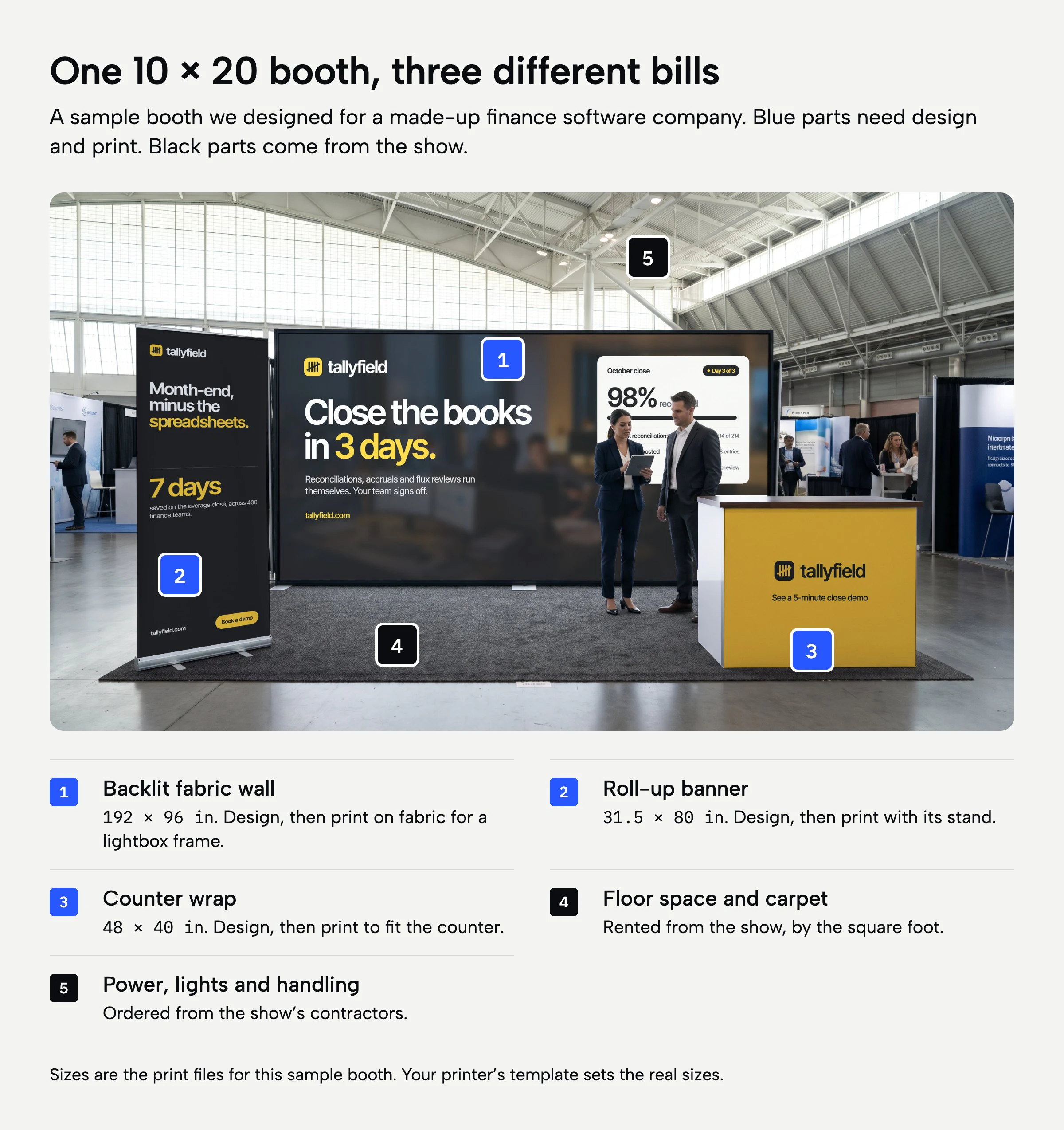
Bill one: the design
Booth graphics look simple: a few big panels with a logo, a line and a photo. But they are some of the hardest pieces a company prints. A visitor often sees your back wall from 30 feet away, while walking, for only a few seconds. The panels are printed 8 feet tall, so a small mistake becomes a big one. And every printer and display maker has its own template, with its own bleed, safe zone and file rules. A file that ignores them comes back, and a late file can miss the ship date.
So most of what you pay a designer for is not decoration. It is these decisions: the one line people can read from the aisle, the logo high enough that heads do not block it, letters big enough to read at a distance, and files built on the printer’s template at full size. On our own booths, for example, we keep the key line above five feet, where heads in the aisle do not cover it, and we make letters at least three inches tall so people can read them from 30 feet.
Here is what the main kinds of design help cost, from their own pages:
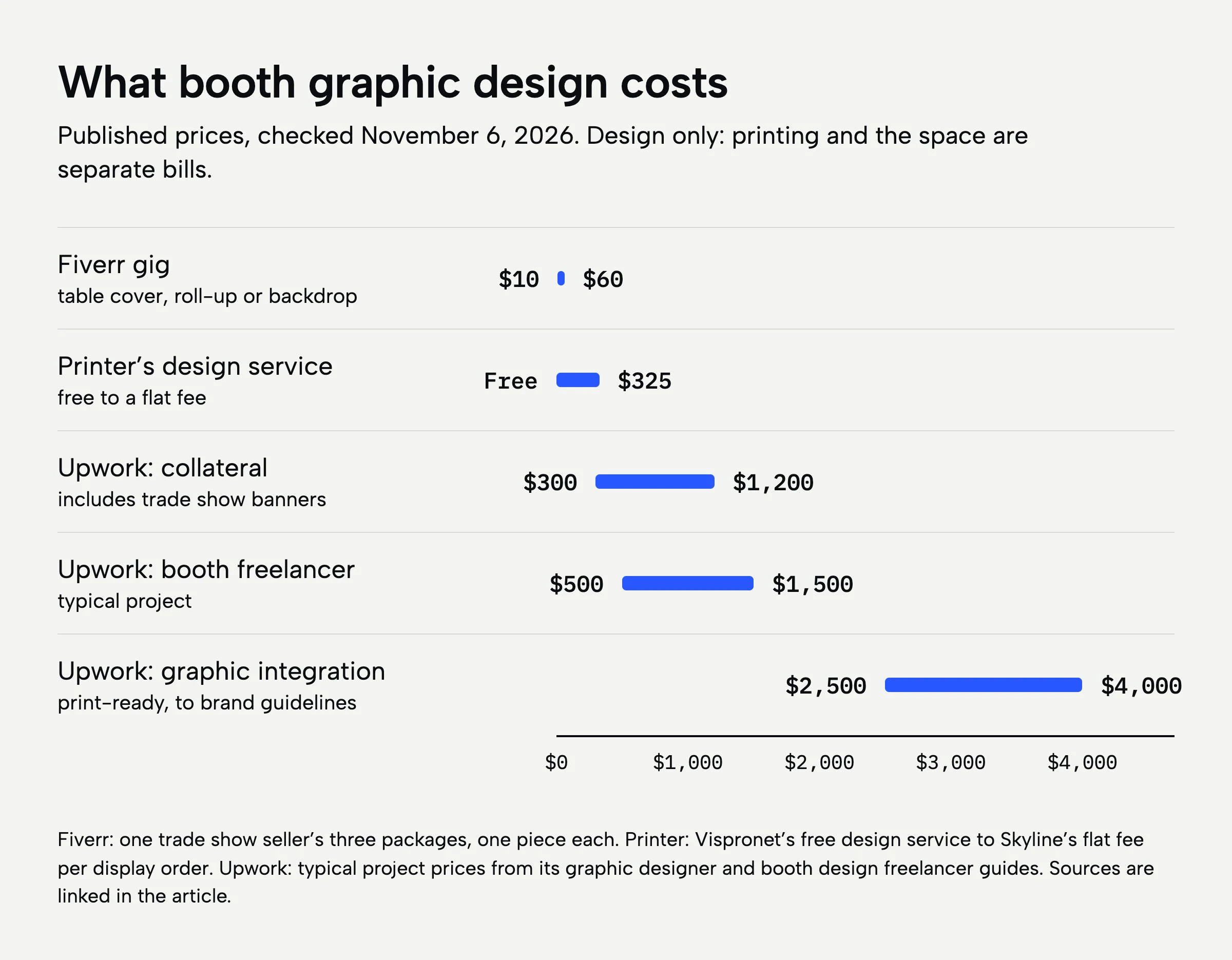
Marketplace gigs are the cheapest route. One Fiverr seller we checked, Baz_ali, offers $10 for a table cover design, $30 for a roll-up banner and $60 for a backdrop. All three include the source file, and the two higher packages add a 3D mockup. Other trade show gigs on the same page start at $20 to $25. At these prices you get a layout, not a plan: no one checks your message against the show, the booth size or the printer’s template unless you do it.
Printers and display makers often design for you. Vispronet offers free design services for layouts, logo cleanup and basic photo work. Signs.com charges $10 and credits it to your order. Displays2go charges $45 an hour. Skyline charges a flat $325 per display order, with a meeting, a first concept and up to two rounds of changes. This is a good route when you need one roll-up banner from a logo and a sentence, and the printer’s template is the one they made. It is a weaker route when the booth must match your brand, your sales deck and your pre-show emails, because the printer’s job is to sell the print.
Freelance designers charge by the project. Upwork’s guide to graphic designers puts marketing collateral, including trade show banners and signage, at $300 to $1,200 a project, and says graphic designers on its platform generally charge $15 to $35 an hour, and up to $60 to $120 for complex work, fast deadlines or more experience. Its separate guide to booth design freelancers says $500 to $1,500 is a typical range for focused booth work. It lists “graphic integration”, which it describes as print-ready graphics that follow your brand guidelines, at $2,500 to $4,000. That last range is closest to what most B2B companies need for a full 10 × 20 booth: a back wall, a counter, banners and the matching social posts.
Studios and exhibit houses sit at the top. An exhibit house that also builds or rents the booth often includes the graphic design in one price. Exhibit Rentals, a Chicago rental company, prices a 10 × 10 rental booth at $11,400 to $17,500 per show, including design, build, graphics, freight and setup. The show’s floor space is not part of that price. That is easy to buy, and you do not own the booth after the show.
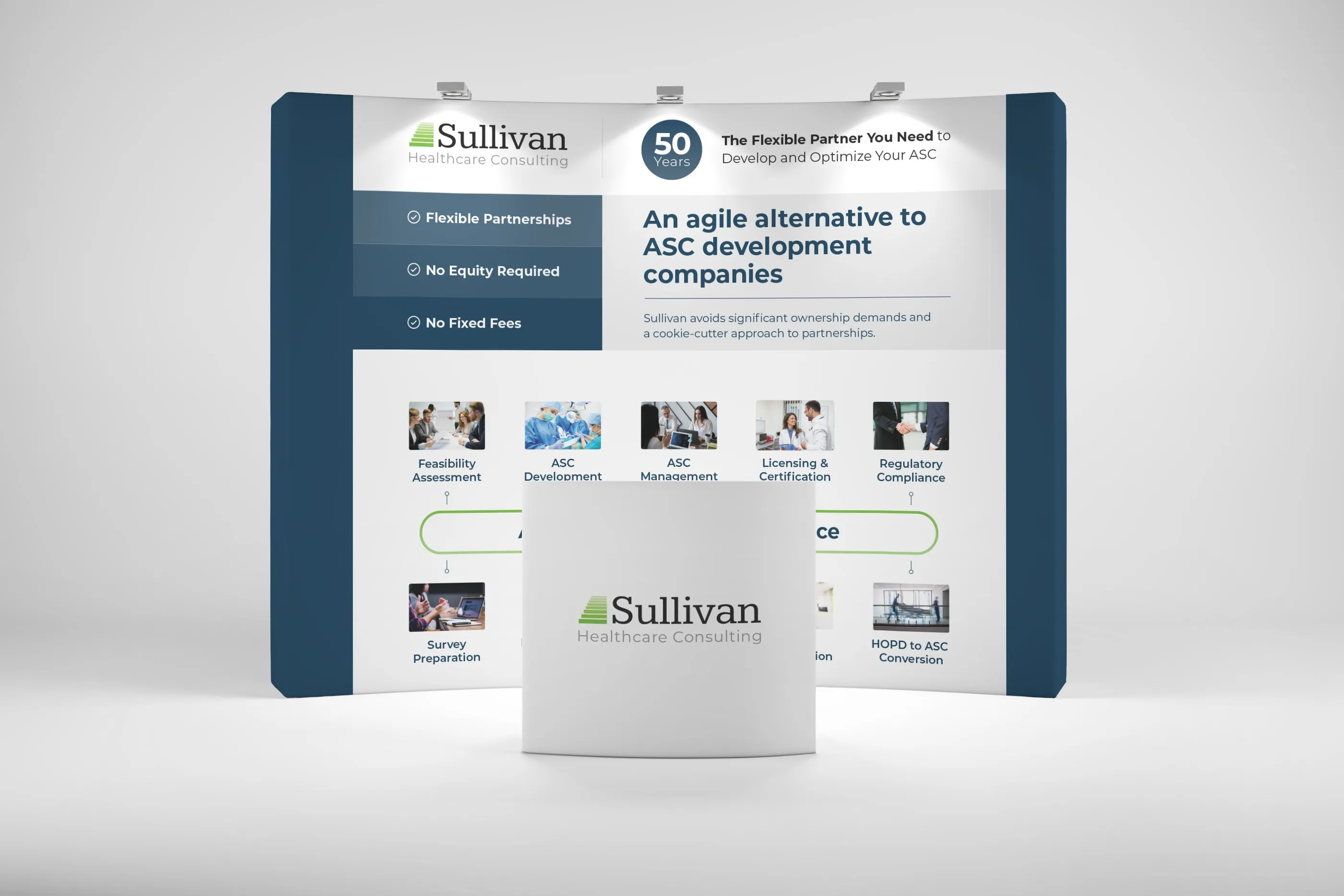
The pop-up booth above is one we designed for Sullivan Healthcare Consulting, an ongoing client, for the company’s 50th year. We also designed the booth before it, for its 40th. The message reads from the aisle in one line, the three proof points sit at eye level, and the service tiles give the sales team something to point at in a conversation. You can see more of that work in our Kirby Bates and Sullivan case study.
A few things change the design price, and they are worth asking about up front. The number of pieces: a booth is rarely one file. A 10 × 20 often needs a back wall, a counter, two banners, a table cover and a few social posts. Templates: a design that starts on your printer’s template costs less to fix later. Last year’s files: updating a booth you already own is usually faster than starting over. Photos: a booth photo printed 8 feet tall needs a big, sharp original or a licensed stock photo. Pre-show pieces: emails, social posts and badges in the same look as the booth bring people to it, and they cost far less when they are designed together.
Bill two: printing and hardware
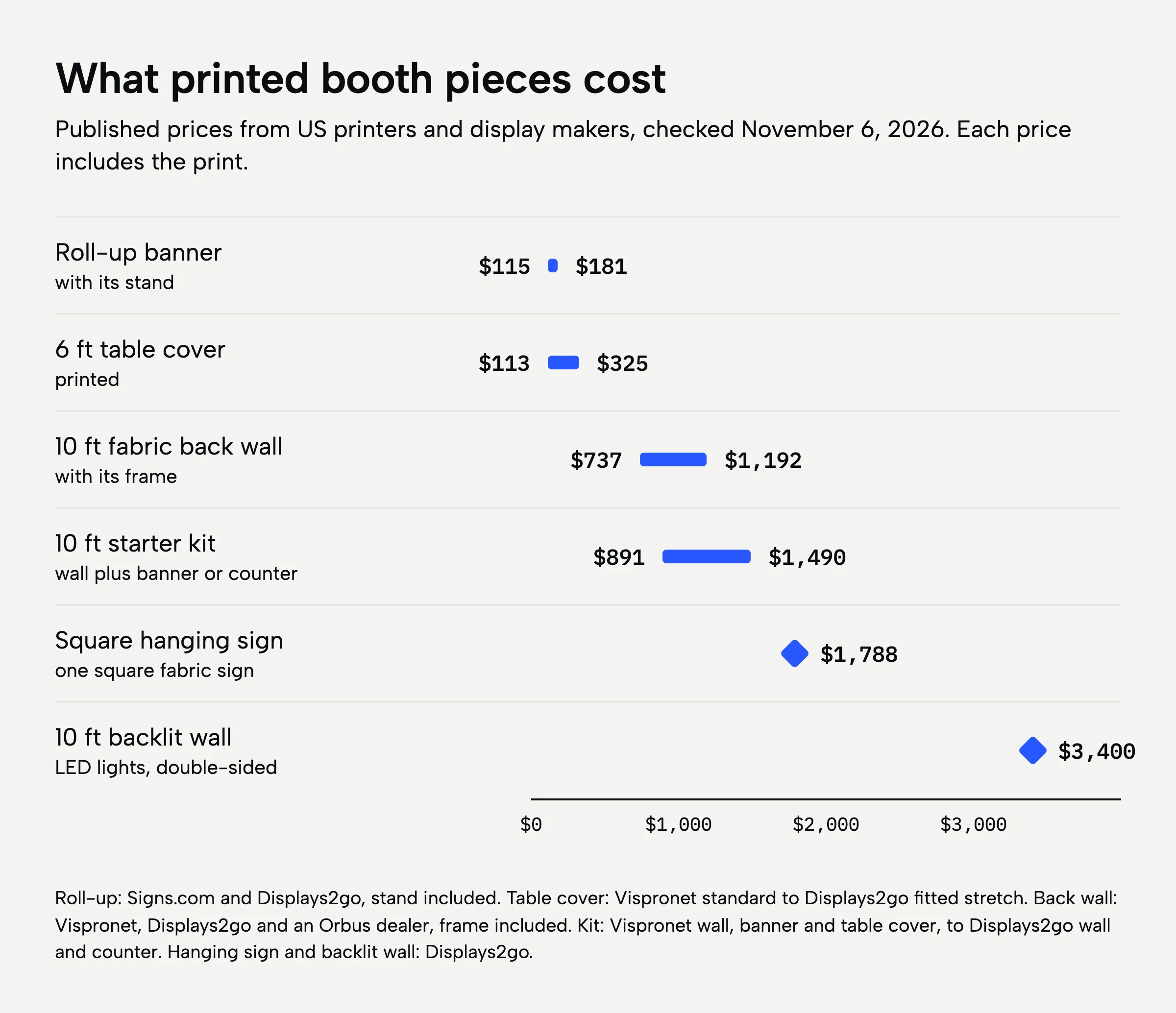
Printing is the bill most people expect, and the published prices are easy to compare. Here is what the main pieces cost from US printers and display makers on November 6, 2026, each with its print included:
| Piece | Published price | Worth knowing |
|---|---|---|
| Roll-up banner, with stand | $115.32 at Signs.com, 24 × 81 in$180.99 at Displays2go, 33 × 81 in | Displays2go ships in about 3 business days after a 2-day proof |
| 6 ft table cover | $112.99–$199.99 at Vispronet$324.99 fitted stretch at Displays2go | The price depends on the style and how much is printed |
| 10 ft fabric back wall | $736.99 at Vispronet$792.99 at Displays2go | Frame and printed fabric included |
| 10 ft Orbus Formulate wall | $1,192 at Power Graphicsan Orbus dealer | A sturdier frame system that grows with your booth |
| Replacement graphic for that wall | $308.99 at Displays2godouble-sided | Next year, you reprint the fabric, not the frame |
| Starter kit | $890.99 at Vispronetwall, banner and table cover | A complete 10 × 10 in one order |
| 10 ft kit with a counter | $1,489.99 at Displays2gowall and portable counter | Ships in about 5 business days after the proof |
| 10 ft backlit fabric wall | $3,399.99 at Displays2godouble-sided, LED lights | Ships in about 5 business days after the proof |
| Square hanging sign | $1,787.99 at Displays2goone square fabric sign | Many shows allow hanging signs only over island or peninsula booths |
Sources: Signs.com, Displays2go roll-up, Vispronet table covers, Displays2go table covers, Vispronet back wall, Displays2go back wall, Displays2go replacement graphic, Power Graphics, Vispronet kit, Displays2go kit, Displays2go backlit wall and Displays2go hanging signs.
Two things in that table save real money. First, the frame lasts for years, and the fabric does not have to. A new graphic for the Displays2go back wall costs $308.99, against $792.99 for the wall with its frame. So once you own the hardware, a new message for next year’s show is mostly a design cost. GES, one of the largest show contractors, says in its budgeting guide that booth graphics last about a year on average. Second, printers publish their production times, and many do not count the proof step. Displays2go, for example, adds two business days for artwork approval before its three to five days of production. A design that arrives late costs a rush fee, or a missed show.
Bill three: the space and the show
The space is usually the biggest bill. You rent the floor from the show organizer, and the price depends on the show, the size and where the booth is on the floor. Here is what four real shows charge, from their own exhibitor pages:
| Show | Published price | A 10 × 10 booth |
|---|---|---|
| TCEA 2027, San Antonio | $1,450 inline, $1,550 cornerflooring required, not included | $1,450 |
| AUA 2027, San Diego | $45.50 a square foot inline$46.50 for islands | $4,550 |
| DIA 2027, San Diego | $6,000 per 10 × 10$250 per corner | $6,000 |
| Natural Products Expo West, Anaheim | $9,384 inline, $10,929 cornerlast published pricing, labeled 2025 | $9,384 |
Sources: TCEA, AUA, DIA and Expo West. Many large shows, CES among them, do not publish space prices and ask you to contact sales.
The space is only the start of the show bill. Carpet, electricity, internet, furniture, lead scanners and the labor to set up and take down the booth are ordered separately from the show’s contractors. Shipping has its own cost too. Your crates go to a warehouse, and the show’s contractor moves them to your booth and back, by weight. At AHR Expo 2027 in Chicago, for example, the published material handling rate is $2.50 a pound, so 400 pounds of crates cost about $1,000 to move.
That is why the industry uses a simple rule. GES says industry surveys put the total cost of a show at about three times the cost of the space. The Center for Exhibition Industry Research (CEIR) found in its 2026 study that space is 40.5% of what exhibitors spend, the biggest single part, as reported by Trade Show Executive. Graphics and their design are a much smaller part of the bill. They are also the only part a visitor actually reads.
Three booths, priced out
A range only helps once you see it on a real booth. Here are three common ones, priced with the published numbers above. These are not quotes from any company. They count only the three bills in this guide: the design, the printed pieces and the space. Travel, shipping, show services and staff come on top.
| Booth | Design + print | With the space |
|---|---|---|
| Regional show10 × 10 at TCEA 2027 | $891 kit + $0–$1,200 design$891–$2,091 | $2,341–$3,541 |
| National show10 × 20 at DIA 2027 | $1,998 pieces + $2,500–$4,000 design$4,498–$5,998 | $16,498–$17,998 |
| Large show20 × 20 island at Expo West | $8,588 pieces + $2,500–$4,000 design$11,088–$12,588 | $59,932–$61,432 |
A 10 × 10 at a regional show. A software company takes its first booth at a regional education show. The space at TCEA 2027 is $1,450. Vispronet’s starter kit, with a 10-foot back wall, a roll-up banner and a table cover, is $890.99. The design can cost nothing, through the printer’s free service, or $300 to $1,200 from a freelancer, on Upwork’s collateral range. So the three bills come to $2,341 to $3,541. At this size, design can be a third of the total, which is why the free option is tempting. It is also where a clear, readable wall makes the biggest difference, because a small booth has one wall to do all the work.
A 10 × 20 at a national show. A medical device company exhibits at a national industry meeting. Two 10 × 10 spaces at DIA 2027 cost 2 × $6,000 = $12,000. The pieces: Vispronet’s 20-foot tension wall at $1,310.99, two Displays2go roll-up banners at 2 × $180.99 = $361.98 and a $324.99 fitted table cover, so about $1,998. The design at Upwork’s “graphic integration” range is $2,500 to $4,000. Together that is $16,498 to $17,998, and by GES’s rule the whole show, with travel and services, could come to about 3 × $12,000 = $36,000. The design is about a tenth of that.
A 20 × 20 island at a large show. A food brand takes an island at Natural Products Expo West, at $48,844 on the show’s last published price list. The pieces: a square hanging sign at $1,787.99 and two 10-foot backlit walls at 2 × $3,399.99 = $6,799.98, so about $8,588. With $2,500 to $4,000 of design, the three bills come to $59,932 to $61,432. By the three-times rule, the whole show is closer to $147,000. Many islands are custom builds from an exhibit house, which costs more, but the pattern holds: the bigger the show, the smaller the design’s share of the bill.
Across the three booths, the space costs the most, and you pay it whether or not anyone stops. The design costs the least at a big show, and it decides whether people stop.
What the money should buy
Companies go to trade shows to meet people, not to sell on the spot. In a CEIR study reported by Association Conventions & Facilities, 64% of exhibitors named lead generation as a goal and 60% named brand awareness, while only 13% said closing sales on the floor. Both main goals start the same way: someone in the aisle has to understand who you are and what you do before they walk past.
That is the job of the graphics, and it gives you a simple test for any design you pay for. Stand 30 feet away from a full-size print, or from the mockup on a screen at that scale. Can you read the main line? Do you know what the company does in three seconds? Is the logo above the height of a person’s head? If not, the booth will look busy and people will walk past, whatever it costs.
A good designer also plans back from the show, not forward from the brief. Printers often need files two to four weeks before the show, and the freight has its own deadline at the show’s warehouse. For a typical show, the plan looks like this:
- Eight to ten weeks before the show: send the brief, the booth size and your printer’s template.
- Five to seven weeks before: approve the design, seen on a photo of your booth size.
- Three to four weeks before: send the final files to the printer. Allow two days for the proof and a week for production.
- One to three weeks before: ship to the show’s advance warehouse before its deadline, so you do not pay late fees.
- Show week: the booth goes up from the parts you already checked.
Then there are the pieces around the booth. Pre-show emails and social posts tell people where to find you. Handouts and slides carry the conversation after the booth. When they share one look with the walls, people recognize you in the aisle, and the cost to design them together is small next to the space.
How to get a quote you can compare
Two quotes for “booth graphics” can describe very different jobs. Before you compare prices, make sure you compare the same thing. Ask every designer these seven questions:
- Which pieces are included? List them: back wall, counter, banners, table cover, hanging sign, social posts. Get the list in writing.
- Is the design built on my printer’s template? At full size, with bleed and safe zones set to their specs.
- Is printing included, or design only? Many printers include design. Many designers do not include printing.
- How many rounds of changes are included? And what does the next round cost?
- Will I see the design on my booth size? A mockup at the real proportions shows problems a flat file hides.
- Who talks to the printer? Someone has to answer the printer’s questions about files, quickly, before the deadline.
- Do I get the source files? You need them to update the booth next year without starting over.
When you ask for quotes, send the same brief to everyone: the show, the dates, the booth size, your printer’s or exhibit house’s templates, your brand files and last year’s files if you have them. Then each designer prices the same real booth, and the quotes line up.
Here is how we work. We design the pieces and prepare the files, and your printer or exhibit house produces them. We work from their templates, answer their questions directly and plan back from their deadline. You see every piece on a photo of your booth size before anything goes to print. Every show is different, so we quote after we see your brief: one fixed price for the whole show within one business day, and it does not change unless the work changes. You can see sample booths, with the files we would send, on our events and trade show page.
Quick answers
How much does trade show booth graphic design cost?
The design of booth graphics costs about $10 to $60 a piece from marketplace sellers, free to $325 from many printers, and $300 to $4,000 from freelance designers, by Upwork’s guides, depending on the number of pieces. Upwork’s own guide puts print-ready booth graphics that follow brand guidelines at $2,500 to $4,000. Printing and the booth space are separate bills.
How much does it cost to print a 10 × 10 trade show booth?
A basic 10 × 10 set with a 10-foot fabric back wall, a roll-up banner and a table cover costs about $900 from US online printers, such as Vispronet’s $890.99 kit. A 10-foot fabric wall alone costs about $737 to $1,192 with its frame, from Vispronet, Displays2go and an Orbus dealer. A backlit 10-foot wall costs about $3,400.
How much does booth space cost at a trade show?
At the shows we checked, a 10 × 10 inline space costs $1,450 at a regional show and $4,550 to $9,384 at national shows. The top figure is from Expo West’s last published list, from 2025. Corner and island spaces cost more. Carpet, electricity and setup labor are usually extra. GES says the total cost of a show is about three times the space.
How long does it take to design and print booth graphics?
Design takes one to three weeks, including changes. Online printers then need about two business days for the proof and three to five business days for production, plus shipping. Plan to send final files three to four weeks before the show, and earlier if your exhibit house or the show’s warehouse sets an earlier deadline.
Is it cheaper to use the printer’s free design service?
For one roll-up banner from a logo and a sentence, yes, and it works well. For a full booth that must match your brand and read from across the hall, a designer who plans the message, the sizes and the files across every piece usually costs less than a reprint or a booth that people walk past.
Can I reuse my booth graphics next year?
The frames and hardware last for years. The fabric graphics usually last about a year, and new fabric for an existing frame costs much less than a new wall: about $309 against $793 at Displays2go for a 10-foot wall. A message update is then mostly a design cost.


