How much does presentation design cost in 2026?
Real 2026 prices for presentation design: AI tools, per-slide services, freelancers, subscriptions and in-house designers, with the math for real decks.
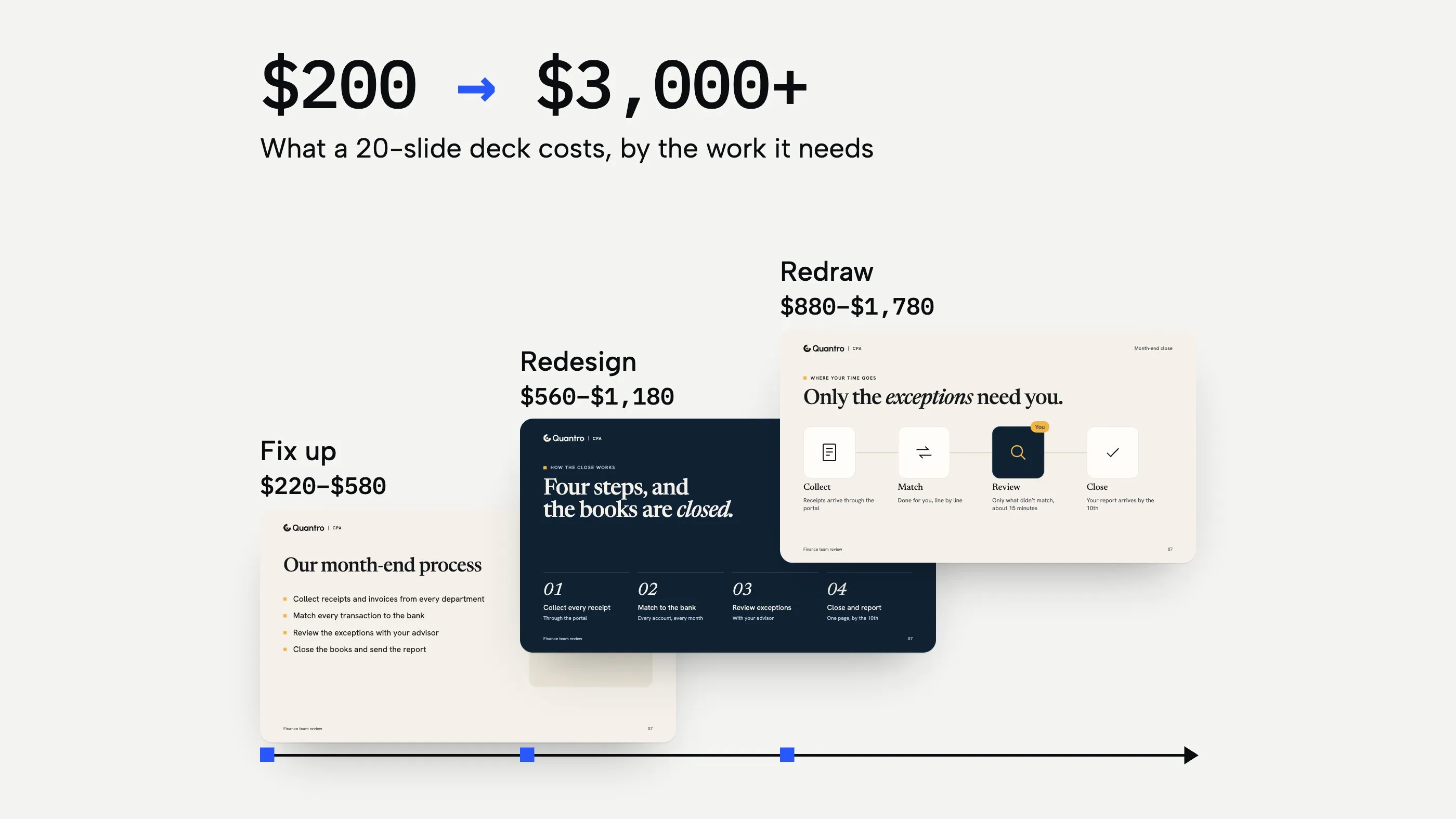
A professionally designed 20-slide deck costs anywhere from about $200 to $3,000 or more in 2026. That is a wide range, and it should be. At the low end, an online service tidies slides you already made, with three days’ notice. At the high end, a specialist writes the story with you, turns your numbers into clear charts and draws visuals that exist nowhere else. AI tools cost less than any of these, but they move the work to you instead of removing it.
We design decks for a living, so we wanted a straight answer we could stand behind. On October 17, 2026, we checked the published prices of every kind of option we could find: AI tools, online slide services, freelance marketplaces, design subscriptions and in-house salaries. We used a 20-slide deck for the math, because that is about the size DocSend recommends for a seed pitch deck, and it is a common size for a sales deck too. Many specialist agencies, Duarte among them, don’t publish prices. They scope each project after a call, so they are not in the numbers below.
This guide is long because the honest answer has parts. Start with the summary if you need a number today. Read on if you want to know why two quotes for “a 20-slide deck” can be $300 and $3,000, and how to tell which one you actually need.
The short answer
| Option | What you pay | A 20-slide deck |
|---|---|---|
| Do it yourselfAI tools: Gamma, Canva, Copilot | $9–$30 a month per personbilled yearly | $108–$360 a year, plus your time |
| Online service24Slides or Slides IQ, per slide | $10–$89 a slideby the work and the deadline | $200–$1,780 |
| PackageSlidebean pitch deck | $799design and writing, 4 business days | Up to 20 slides |
| FreelancerUpwork presentation designer | $35–$60 an hourmedian, worldwide | $1,000–$3,000 for a pitch or sales deck |
| SubscriptionUnlimited design requests | $699 a monthone example, two requests at a time | One month of the plan |
| In-houseA full-time graphic designer | $62,960 a yearUS median salary | Salary only, before benefits and tools |
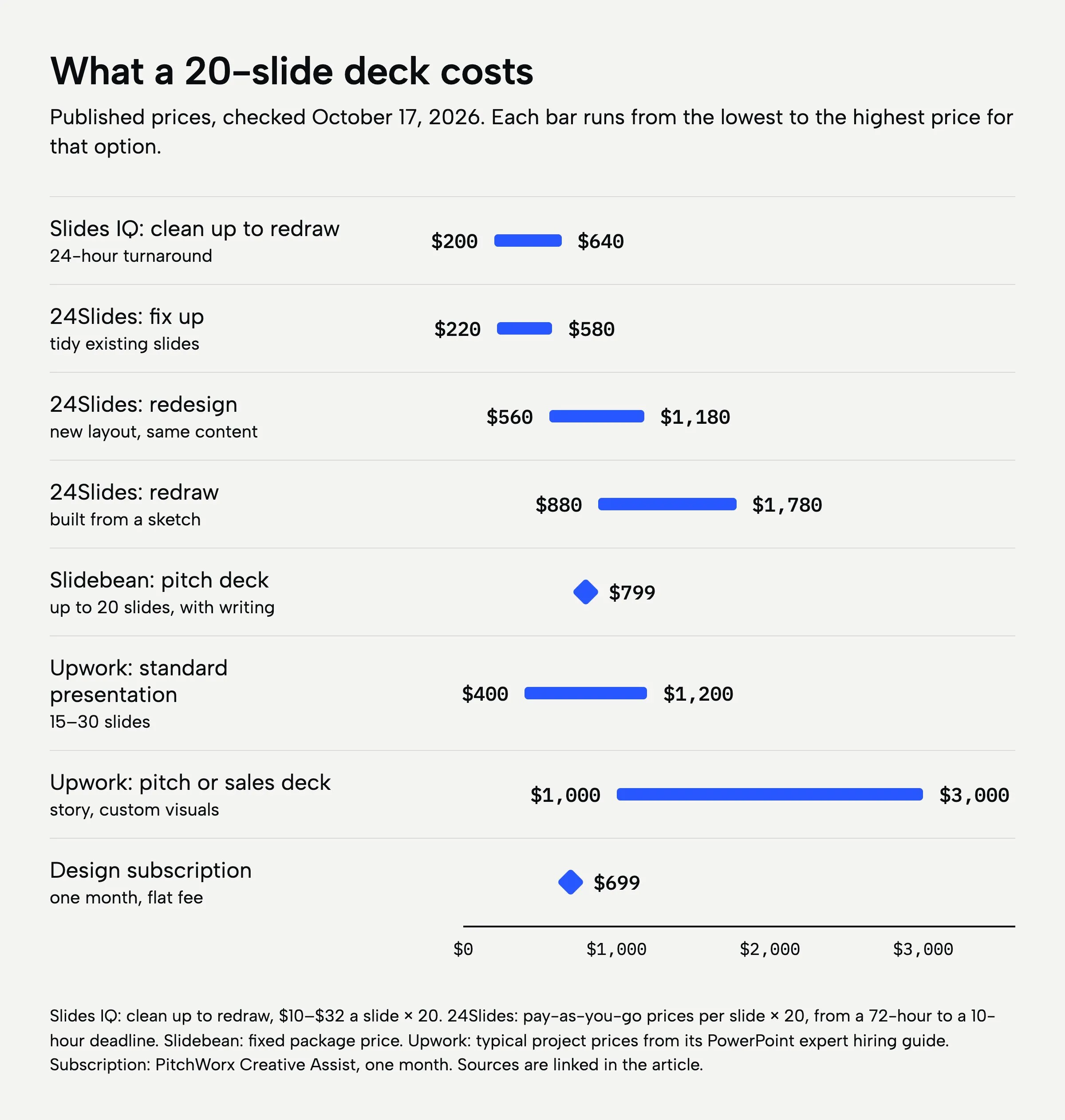
Every figure is linked to its source in the sections below. If you only remember one thing, make it this: a price per slide means little until you know how much work each slide needs.
What you are really paying for
Most of the price of a deck is a designer’s time. Software, fonts and photos cost something, but they are small next to the hours. So the useful question is not “how many slides?” but “how long will each slide take?” And that depends far more on the state of your content than on the number of slides.
24Slides makes this easy to see, because it is one of the few companies that publishes a full rate card. It sorts every slide into three kinds of work. A fix up keeps your layout and makes it clean: the right fonts and colors, aligned, with consistent spacing. A redesign keeps your content but gives it a new layout and new visuals. A redraw starts from a rough sketch or a paragraph of notes and builds the slide from scratch. With a 24-hour deadline, those cost $16, $43 and $66 a slide. The same slide can cost four times more, depending only on how far it has to travel.
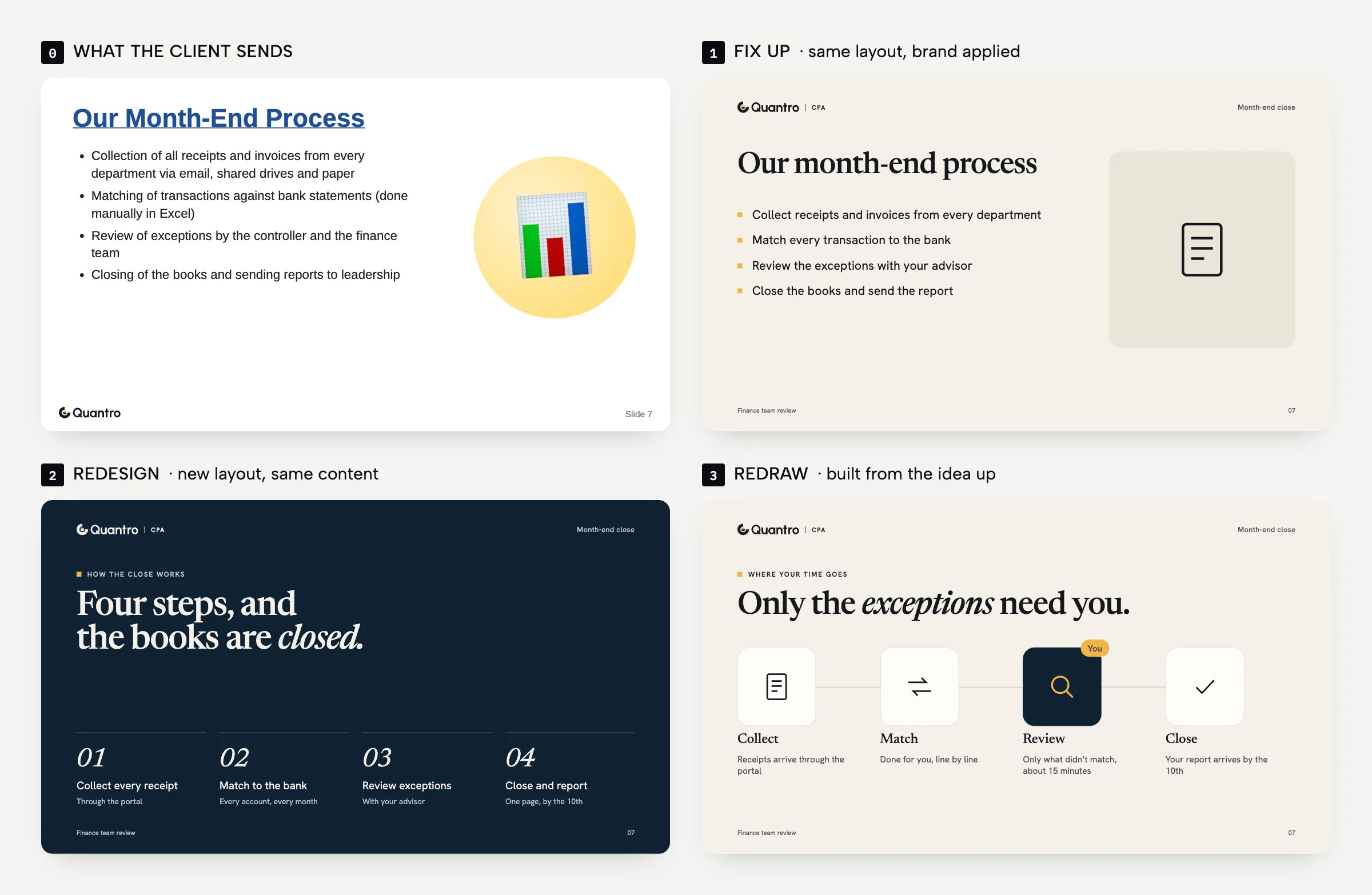
We made the example above with Quantro, a sample accounting firm we designed for our website demos. The client’s slide on the left has the right information. What it lacks is a decision about what matters. The fix up makes it presentable in an hour. The redesign makes the sequence obvious. The redraw changes the message itself: instead of listing four steps, it shows the client the one step that still needs them. Each step to the right is worth more to the audience, and each one takes more of a designer’s time. A quote that says “$40 a slide” tells you nothing until you know which of these four slides you will get.
In more than 20 years of design work, including our time at Duarte and decks for Salesforce, Apple, Google and DataStax, we’ve seen the same thing again and again: the biggest cost driver is how ready your content is. A deck with a clear story, final numbers and approved wording moves fast, because the designer can spend every hour on design. A deck that still needs its story worked out takes longer, no matter who designs it, because someone has to make the decisions the slides are waiting for. If you can finish your outline and your numbers before you hire anyone, you will pay less and get a better deck.
Charts and data are the next big factor. A chart that only needs your brand colors is quick. A chart where a designer has to understand your spreadsheet, decide what it proves and show that one point clearly is real work, and it is often the most valuable work in the deck. The same goes for custom icons, diagrams and illustrations: a set made for your deck costs more than a stock icon pack, and it is what makes a deck look like yours and nobody else’s.
Then there is the deadline. Time costs money in this business, and the published prices show exactly how much.
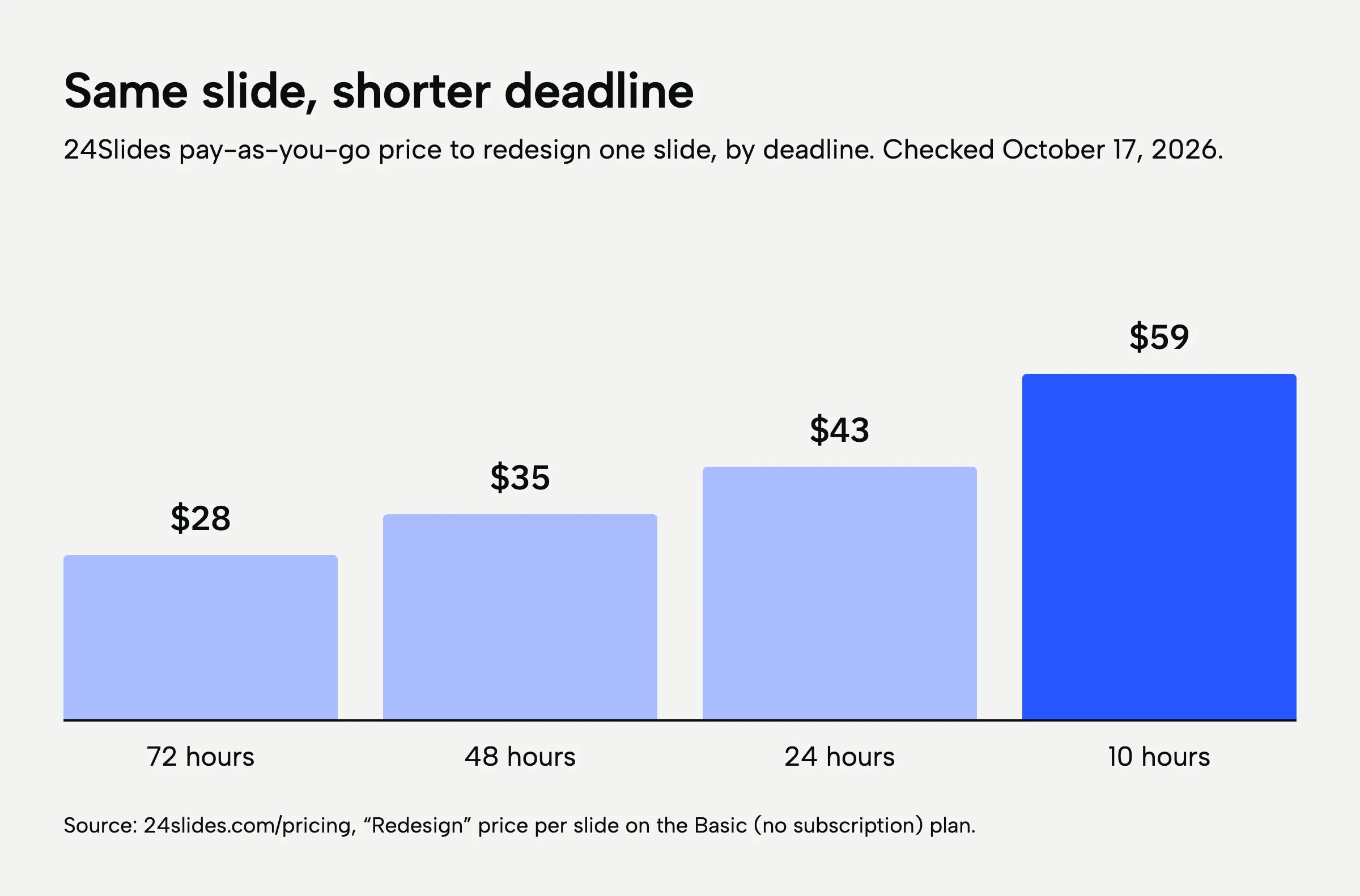
The same redesigned slide costs $28 with three days’ notice and $59 with ten hours. That is more than double for the same work. If your deadline is fixed, the cheapest thing you can do is start earlier.
A few smaller things also change the price, and they are worth asking about up front. Rounds of changes: most quotes include one or two, and the next one costs extra. Editable files: you want a file your team can open and change in the app you present from, not only a PDF. Fonts and photos: if your brand uses a paid font or the deck needs licensed photos, someone pays for those licenses. Adobe Stock, for example, starts at $29.99 a month for up to 10 images. A master template: a set of slide layouts your team can reuse costs more once, and then every future deck starts faster and stays on brand.
Doing it yourself with AI tools
AI tools are now the cheapest way to get a deck that looks finished. Here is what the main ones cost, from their own pricing pages on October 17, 2026:
| Tool | Published price | Worth knowing |
|---|---|---|
| Gamma | Free to try$9 or $18 a month per person, billed yearly | Custom branding is on the $18 Pro plan |
| Canva | Pro: $144 a yearfor one person | Business is $250 a year per person |
| Beautiful.ai | Pro: $14.50 a monthbilled yearly | PowerPoint import and export included |
| Microsoft 365 Copilot | $30 a month per personbilled yearly | On top of a Microsoft 365 plan |
| Google Workspace with Gemini | $14 a month per personStandard plan and up | Not on the $7 Starter plan |
Sources: Gamma, Canva, Beautiful.ai, Microsoft and Google Workspace.
These tools are genuinely good at one thing: a fast first draft. Give them an outline and they return a full deck in minutes, with layouts, headings and pictures. For an internal update, a class or a first pass at an idea, that may be all you need.
For a deck that has to win something, the limits matter, and the vendors are honest about them in their own help pages. Microsoft says Copilot in PowerPoint “can’t understand meaning or evaluate accuracy,” so someone still has to check every claim and every number. The same page says only people with a Copilot license can use your company’s branding with it. Gamma notes that its PowerPoint exports can look different from what you see in its editor, and that Google Slides replaces your fonts with its own. Beautiful.ai’s own blog says animations won’t carry over to PowerPoint when you export.
None of that makes the tools bad. It means the real price of this route is your team’s time. Someone still decides what the deck needs to prove, writes the words, checks the numbers, and fixes the slides the tool got wrong. Those hours are not free; they are simply not on an invoice. The median US advertising, promotions and marketing manager earns $79.70 an hour, according to the Bureau of Labor Statistics. If a deck takes that person two full working days, that is about $1,275 of their time, before you count the work they didn’t do instead. The tools also work much better when they have clear brand rules to follow. We wrote a separate guide on setting up your brand guidelines so AI tools follow them.
Hiring help: services, freelancers, subscriptions and staff
Online slide services like 24Slides work like a production line. You upload your slides and your brand guidelines, choose the kind of work and the deadline, and get the deck back. For a 20-slide deck, its published prices come to $220 for a light fix up with three days’ notice and $1,780 to redraw every slide in ten hours. Most decks land in between. Slides IQ uses the same three kinds of work and charges $10, $25 and $32 a slide with a 24-hour turnaround, so the same 20 slides cost $200 to $640 there. Some services sell a fixed package instead: Slidebean charges $799 for a pitch deck of up to 20 slides, including help writing it, delivered in four business days. This is a good fit when your content and story are already done and you need them to look professional quickly. It is a weaker fit when you are not sure what the deck should say, because a production line is built to execute decisions, not to make them with you.
Freelancers cover the widest range of all, from students to senior specialists. Upwork says presentation designers on its platform charge a median of $35 to $60 an hour, based on past contracts worldwide, and its guide to hiring PowerPoint experts gives typical project prices:
| Project | What it usually includes | Typical price |
|---|---|---|
| Simple deck | 10–15 slidesclean formatting, basic charts | $150–$400 |
| Standard presentation | 15–30 slidescustom layouts, data visuals | $400–$1,200 |
| Pitch or sales deck | story structurecustom icons and illustrations | $1,000–$3,000 |
| Branded template | master with 10–20 layoutsa guide for your team | $500–$2,000 |
Those are ranges, not quotes. The same page shows freelancers charging anywhere from $5 to $150 an hour, and a low rate can be a real bargain or a template reused for every client. The way to tell is to look at decks they made for companies like yours, not only their three best slides. Ask what they did and what the client gave them. A beautiful slide built from a finished brief proves less than a clear slide built from a messy one.
Design subscriptions charge a flat monthly fee for a steady stream of requests, worked on a few at a time. PitchWorx, for example, charges $699 a month with two active requests and editable source files. This model suits a marketing team that needs new slides every week: event decks, webinar slides, quick sales one-pagers. For one important deck, you pay for a month of capacity you may not use, and you may not get the same designer twice.
An in-house designer costs more than any of these in total, and can be worth it. The US median salary for a graphic designer is $62,960 a year, or $30.27 an hour, according to the Bureau of Labor Statistics (May 2025 data). That is salary only. Benefits, software, fonts, stock photos and management time come on top. An in-house designer makes sense when decks are a weekly job and the brand needs one person to protect it. Not every graphic designer has deck experience, so ask to see decks, not only logos and ads.
Specialist agencies and studios sit above all of this. They usually quote per project after a conversation, because the work starts with the story, not the slides. You are paying for judgment: someone who has built many decks like yours and knows what the audience will ask on slide three.
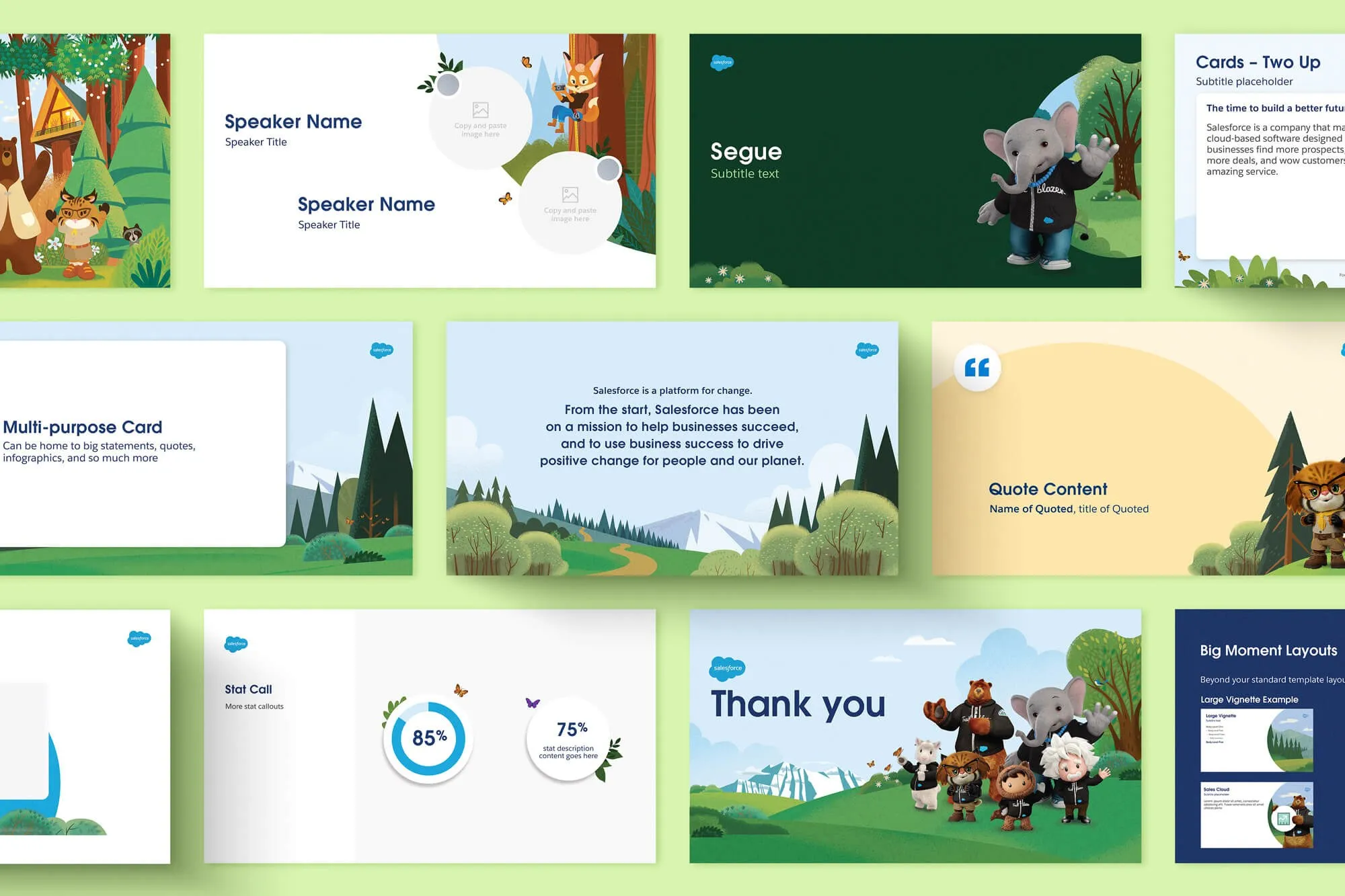
A master template is a good example of where that judgment pays off. The Salesforce slides above come from a template system we designed: title slides, speaker slides, quotes and data callouts that a whole team can reuse. It costs more once than a single deck. After that, every new presentation starts from approved layouts instead of a blank slide, and nobody has to rebuild the brand by hand.
Three decks, priced out
Ranges are easier to use with real examples. Here are three common situations, priced with the published numbers above. These are not quotes from any company; they show how the math changes when the job changes.
A seed pitch deck, content ready. A founder has a 20-slide deck with a finished story and final numbers, and three days before the first investor meeting. The slides need new layouts, not new content. At 24Slides’ redesign price with a 72-hour deadline, that is 20 × $28 = $560. If the founder also wants help with the story and custom visuals, the job moves into Upwork’s pitch-deck range of $1,000 to $3,000, or into a specialist’s quote.
A sales team that needs a system. A company’s sales reps each build their own decks, and none of them match. The fix is a branded template plus one finished 25-slide sales deck built on it. On Upwork’s published ranges, that is $500 to $2,000 for the template and $400 to $1,200 for the deck: $900 to $3,200 in total. After that, every new deck costs less, because the layouts already exist.
A keynote due next week. A conference talk has 40 slides, and most of them are still notes and sketches. Every slide needs a redraw. At 24Slides’ redraw price, 40 × $66 = $2,640 with a 24-hour deadline, and 40 × $89 = $3,560 with ten hours. Starting three days earlier would bring it to 40 × $44 = $1,760: the same slides for about half.
The pattern is the same in all three. The number of slides matters less than how ready the content is and how much time is left. If you want to spend less, finish your thinking before you hire anyone, and start early.
Is a designed deck worth paying for?
A deck is often the one thing a buyer or investor looks at without you in the room. It gets forwarded, opened between meetings and read in a hurry. The data on how people use decks shows why the design work pays off, and why “design” here means much more than decoration.
Attention is short. DocSend found that investors spend an average of 3 minutes and 44 seconds on a seed deck, and only 58% of decks are read to the end. That is about eleven seconds a slide for a 20-slide deck. Each slide has to make its point at a glance.
Shorter decks also seem to win. In Gong’s analysis of 121,828 recorded sales meetings, deals that closed used about 9.1 minutes of slides in the first meeting, while lost deals used about 11.4. That is a pattern in the data, not proof of cause, but it matches what we see: a designer’s most valuable work is often cutting.
And buyers notice when things don’t match. In a Gartner survey of 632 B2B buyers, 69% said what sellers told them didn’t match the company’s website. A deck with different numbers, a different tone or a different look adds to that doubt.
So good presentation design is the work of making a deck short, clear and consistent with the rest of your brand. We go much deeper into the research, including studies on how people learn from slides, in why presentation design matters more than you think.
How to get a quote you can compare
Two quotes for “a 20-slide deck” can describe very different jobs. Before you compare prices, make sure you are comparing the same thing. These seven questions do most of the work:
- Is the price per slide or per deck? And what counts as a slide: does a section break cost the same as a detailed chart?
- Who writes the story and the words? Many prices cover design only. Writing and structure are often extra, and they are where most decks fail.
- How many rounds of changes are included? And what does the next round cost?
- Will you get editable files? In the app your team presents from: PowerPoint, Keynote or Google Slides, plus a PDF.
- Is a master template part of the job? It costs more once, and makes every future deck faster and more consistent.
- What does a rush cost? The published prices above show a tight deadline can double it.
- Who does the work? The person you talked to, or someone you will never meet?
When you ask for quotes, send the same package to everyone: your current deck or notes, your brand guidelines, the deadline, where you will present and what the deck needs to achieve. The quotes will be easier to compare, and the designers can price your real content instead of guessing.
Here is how we do it. We price a deck by the work each slide needs, the same way the rate cards above do: a slide that needs a cleanup costs less than one we build from a rough idea. Send us your deck or your notes and we send you a free quote within one business day, so you know the cost before we start. Two rounds of changes are included, and you get an editable PowerPoint, Keynote or Google Slides file plus a PDF.
You can see some of our work for Salesforce, Apple, Google, DataStax and others. If the deck is for a sales meeting, our guide to presentations that close deals covers the structure, and our investor pitch deck guide covers fundraising. When you have a deck coming up, tell us about it and we’ll send you a quote.